What Happens at the Corner Table Stays at the Corner Table
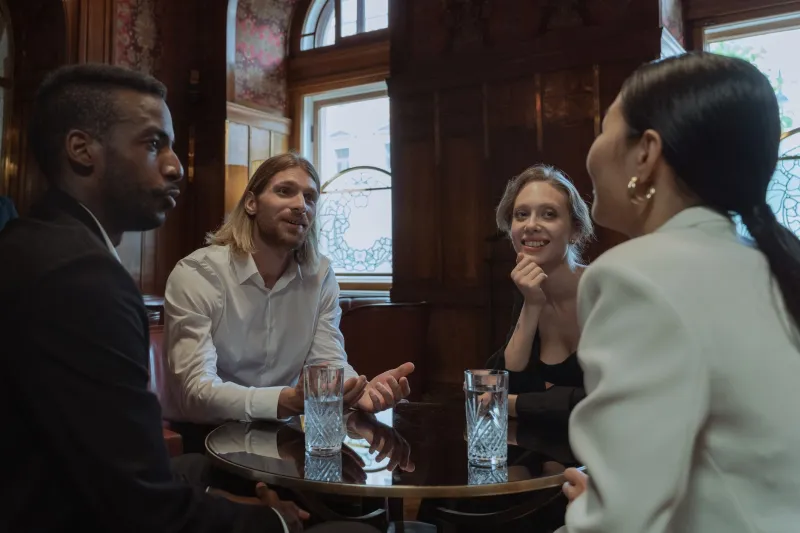
There's a particular corner table at Pigeon Cove Tavern — you probably know the type. It's tucked just far enough from the bar that the noise softens a little, close enough to the window that you catch the last hour of daylight on a Friday evening. It seats four comfortably, six if nobody's precious about elbow room. And if that table could talk, it would have a lot to say.
Taverns have always been more than places to eat and drink. They're holding rooms for human experience — the good, the messy, the awkward, and the genuinely moving. Walk through a busy bar on any given night and you're walking through dozens of private universes, each one orbiting its own center of gravity.
The Anniversary That Almost Wasn't
Consider the couple in the booth near the back. They've been married eleven years. They almost didn't make a reservation tonight — one of them suggested just ordering pizza and calling it done. But something nudged them out the door, into the car, into a place with low lighting and a menu that didn't require anyone to cook or clean up afterward.
They don't talk much at first. They order drinks. They look at their phones for a minute, then put them face-down. Then one of them says something small — a memory about a road trip from years ago — and something shifts. The drinks arrive. The food comes. By the time they're splitting a dessert they swore they didn't want, they're laughing like people who forgot they still liked each other.
Taverns do that. They remove the friction of domestic life — the dishes in the sink, the unread texts, the to-do list pinned to the fridge — and replace it with a neutral space where people can just be together without any of the props of their regular life getting in the way.
The Friend Group Stress Test
Then there's the group of five crowded around a high-top, sharing a basket of wings and a pitcher of something cold. From the outside, it looks like a good time. Look closer and you'll notice two of them are barely making eye contact. There was an argument last week — something that started in a group chat and escalated in ways nobody quite expected. Tonight is the first time they've all been in the same room since.
This is what a shared table does. It forces proximity. It creates a low-stakes environment where people have to at least try — because it's hard to stay furious at someone when you're both reaching for the last celery stick at the same time. The food is a prop. The drinks are a lubricant. The real work is happening in the pauses between bites, in the careful jokes that test whether it's safe to laugh yet.
By the second pitcher, the tension usually breaks. Not because anyone delivered a dramatic speech or issued a formal apology — but because time in a shared space has a way of wearing down the sharp edges. Taverns are, among other things, conflict resolution rooms that never advertise themselves as such.
The Stranger Who Became a Fixture
Not every story at a tavern table involves people who already know each other. Some of the best ones start with a solo diner who gets talked into pulling their chair closer to a neighboring group.
It happens more than you'd think. Someone's eating alone — maybe traveling for work, maybe just in the mood to be around people without committing to actual plans — and the group next to them makes a joke that lands just right. A comment about the game on TV. A shared eye-roll at the wait time. Something small that cracks the door open.
An hour later, that person knows everyone's names and is deep in a conversation about something they haven't thought about in years. They exchange numbers, or they don't. Maybe they never see each other again. But for one evening, a stranger became a temporary regular, and a table that started with four became a table of five.
This is one of the things a neighborhood tavern does better than almost anywhere else. It creates the conditions for accidental community — not forced, not organized, just allowed to happen.
The Conversation That Had Been Waiting Years
Some tables hold heavier things. The father and adult child who haven't found the right words in a long time. The two old friends who drifted apart and finally agreed to meet somewhere that wasn't anyone's home turf. The person who just got hard news and called the one friend they knew would show up without needing an explanation.
There's something about a tavern — the ambient noise that provides just enough cover, the drinks that give hands something to do, the food that creates natural pauses — that makes difficult conversations more possible. Therapists talk about the value of parallel activity in emotional conversations, the idea that doing something side-by-side makes it easier to say hard things than sitting face-to-face in silence. A shared meal at a bar table is a version of that.
People say things in booths they can't say on a couch. They make decisions over cold drinks that they couldn't make in a quiet room. The informal setting strips away some of the weight of the moment just enough to let people actually move through it.
Why It Matters That Places Like This Exist
We talk a lot about community in the abstract — about belonging, about connection, about the loneliness epidemic that keeps showing up in headlines. But community doesn't happen in the abstract. It happens in specific places, at specific tables, between specific people who happened to be in the same room at the same time.
Taverns are one of the last genuinely democratic social spaces in American life. No appointment needed. No agenda required. You can come in for an hour or close the place down. You can be celebrating or grieving or just killing time. The table doesn't judge. The corner doesn't care.
At Pigeon Cove Tavern, we've watched a lot of these moments unfold. We don't always know the whole story — we just know that people came in, sat down, and something happened between them that mattered. Sometimes you can tell by the way they leave: slower than they arrived, a little lighter, a little more settled in themselves.
That's the thing about a good tavern table. It doesn't fix anything. It just gives people a place to sit while they figure out how to fix it themselves.
And sometimes, that's exactly enough.