Good Things Take Time: The Case for Bars That Refuse to Rush You
Somewhere along the way, speed became the currency of the service industry. Apps promise your food in twenty minutes. Bars advertise how fast they can get a drink in your hand. Efficiency metrics crept into spaces that used to be defined by something a lot harder to measure — the feeling that you're exactly where you're supposed to be, with nowhere else to be.
But here's the thing about that feeling: you can't rush it.
The best nights you've ever had at a bar probably didn't start fast. They started slow. A good conversation that found its footing around the second round. A meal that arrived when it was actually ready. A bartender who took the time to build your drink like it mattered, because to them, it did. That kind of experience doesn't happen by accident, and it doesn't happen when everyone behind the bar is sprinting.
What a Deliberate Pour Actually Tells You
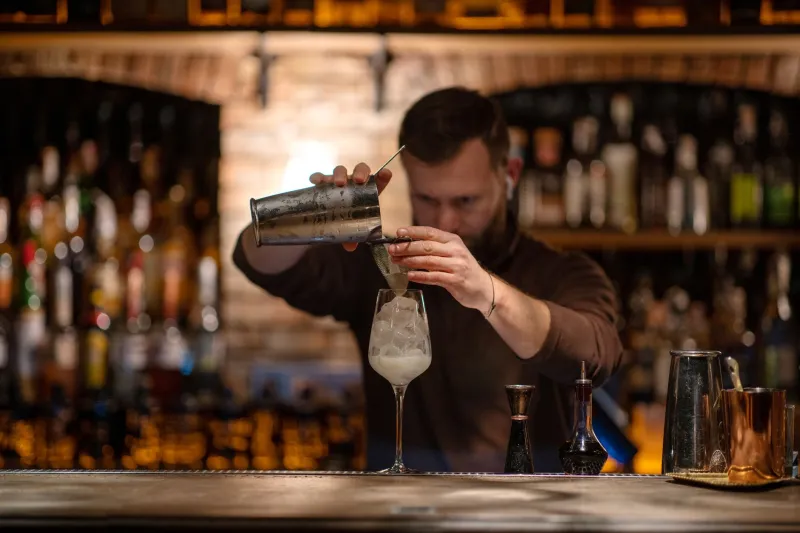
Watch a bartender who cares. Really watch them.
They're not scrambling. They're not cutting corners on the ice, eyeballing the pour, or skipping the step that makes the difference between a good cocktail and a great one. They're moving with purpose — not slow for the sake of slow, but measured in a way that tells you they've done this enough times to know that the details matter.
A properly built drink takes time. A layered whiskey sour needs its shake. A draft beer needs its settle. A martini needs its chill. When a bartender respects those steps, they're not just following a recipe — they're making a quiet promise to you that what ends up in your glass is worth what you paid for it.
Contrast that with the bar where the pours are fast and loose, where ice gets thrown in without thought, where the ratio is whatever happens when someone's moving too quickly to measure. You can taste the difference. Every single time.
The Fast-Food Mentality Creeping Into Bar Culture
This isn't just about cocktails. It's a broader shift that's been happening for years now, and it's worth naming.
The pressure to move people through — to maximize covers, to flip tables, to get the next round out before the last one's half finished — has changed how a lot of bars operate. And some of that is understandable. Running a bar is hard. Margins are thin. Staff is stretched.
But there's a cost to that pressure, and it shows up in the experience. Servers who check in so often they interrupt the conversation, then disappear when you actually need them. Kitchens that send food out before it's right because the ticket time is getting long. Drinks that are technically correct but built without any real attention.
It starts to feel less like hospitality and more like logistics.
The taverns that push back against that — the ones that train their staff to read a table instead of just service it, to build drinks the right way even when it's busy, to let a kitchen run at the pace the food demands — those places are becoming genuinely rare. Which makes them genuinely valuable.
The Thoughtful Check-In vs. The Constant Hover
There's an art to knowing when to show up at a table and when to leave people alone.
A great server doesn't hover. They observe. They notice when glasses are getting low without making a production of it. They sense when a table is deep in conversation and doesn't need an interruption, and they also catch the moment when someone's been waiting a beat too long and needs acknowledgment.
That kind of attentiveness isn't something you can teach with a script. It comes from experience, from genuine interest in the people you're serving, and from working in an environment that values doing things right over doing things fast.
When you find a place like that — where the service feels natural rather than mechanical — you notice it immediately, even if you can't quite articulate what's different. The night just flows. The food arrives when you're ready for it. The drinks are there when you want them. Nobody's rushing you to the check.
That's not an accident. That's craft.
Kitchens That Won't Cut Corners
The same principle applies behind the line.
A kitchen that refuses to rush takes pride in a different kind of metric than ticket time. They care whether the fries are actually crispy, whether the burger is cooked to what you asked for, whether the sauce has had enough time to come together. They'd rather hold a plate for two extra minutes than send out something that's going to disappoint you.
That mentality produces a different product. You can taste the difference between a kitchen that's chasing speed and one that's chasing quality, and they're rarely the same thing.
It also produces a different atmosphere. A kitchen that's constantly in crisis mode — always behind, always rushing — sends that energy out into the dining room whether they mean to or not. A kitchen that's running clean and intentional? That calm carries through, too.
Why It's Worth Seeking Out
We live in a world optimized for speed. Same-day delivery. Instant streaming. Drive-throughs. There's nothing wrong with convenience when convenience is what you need.
But a night out at a great bar or tavern isn't supposed to be convenient. It's supposed to be an experience — something you actually remember, something that feels different from the rest of your day. And experiences worth having almost always require someone, somewhere, taking their time.
The places that understand this — that a great drink is worth building right, that a good meal is worth cooking properly, that a memorable night can't be manufactured on a timer — those are the places worth driving a little farther for, waiting a little longer at, and coming back to again and again.
Here at Pigeon Cove Tavern, that's the standard we hold ourselves to. Good food, great company, cold drinks — but none of it rushed. Because the best things rarely are.
Next time you're in, settle in. Let the night find its pace. We'll take care of the rest.